
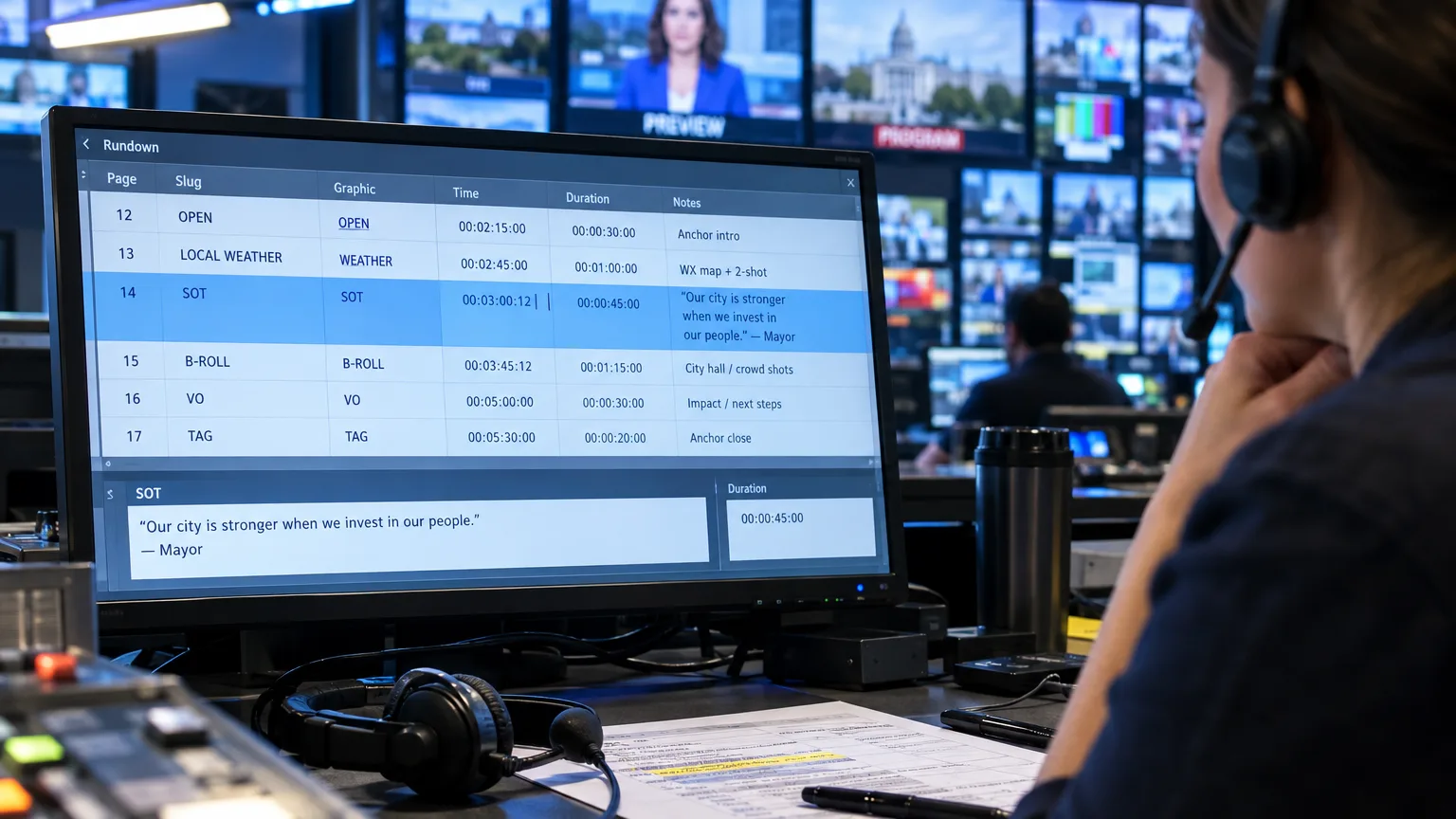
What Is SOT in News Editing? The Broadcast Term for a Quote That's Ready to Air
Somewhere in a control room right now a producer is telling the director to go to the SOT at ten, and the new intern is nodding along, privately assuming it's some kind of condiment. The newsroom asks what it means almost as often. SOT stands for 'sound on tape' and means a soundbite, an on-camera quote from someone other than the reporter or anchor that runs in a news package exactly as the source said it, a raw ingredient the whole newsroom builds a script around.
The term is a relic. Nobody in a 2026 newsroom is cutting actual tape, and most SOTs live in a cloud bin before they ever touch a timeline. But the word stuck the way a lot of broadcast jargon sticks, because it names something precise that still has no better name: the moment the script stops and the real person starts talking.
SOT Definition
What does SOT actually stand for and mean?
SOT is short for 'sound on tape'. In broadcast journalism, SOT is generally considered to be audio captured from an individual who is on camera, like an interviewee, and may also be referred to as a soundbite. In a script or a rundown, SOT marks the exact spot where the reporter's track hands off to the source's own words, on their own voice, uncut by narration.
NBCU Academy's own glossary for newsroom staff lists SOT as another phrase for a soundbite, which tells you how settled the usage is: it's not slang anymore, it's the trade's actual vocabulary, printed in training materials for new hires. Producers say it out loud as a word, not three letters, the same way they'd say 'package' or 'VO'.
VO/SOT Breakdown
What's the difference between a VO, an SOT and a VO/SOT?
A VO/SOT is a script structure, not a synonym for SOT itself: it's a VO, then a bite. A VO (voiceover) is the anchor reading script live over video, no reporter track, no soundbite, just pictures and a read. An SOT is the bite itself. Put them together and you get a VO/SOT, pronounced 'vo-sot' in most shops, which is a type of video news presentation that includes both a VO portion and a soundbite, usually anchored live in the studio and running sixty to ninety seconds.
That's one rung below a full package (sometimes 'pkg'), which adds a reporter track laid over multiple SOTs, natural sound, and a sign-off. The hierarchy most newsrooms teach new writers runs roughly: reader (anchor copy, no video) → VO (anchor copy, with video) → VO/SOT (anchor copy, video, one bite) → package (reporter-voiced, multiple bites, natural sound, often a stand-up). An SOT is the atomic unit that gets reused across all of the heavier formats. Learn it once and you can read a rundown in any newsroom in the country.
SOT vs Soundbite
Is an SOT the same thing as a soundbite, and how is it different from a selects reel?
Functionally, yes: SOT and soundbite are interchangeable in most American TV newsrooms, with SOT being the term you'll see printed in a script or rundown and 'soundbite' or 'bite' being what people say out loud in the hallway. Where it gets confusing is when documentary and corporate editors borrow the word 'soundbite' loosely to mean any good quote, because that's not quite the same unit of work as broadcast news uses.
An SOT is written to a strict runtime (often soundbites on average run only about nine to ten seconds, with fifteen seconds considered the upper bound for television news), chosen because it's both technically clean and editorially clear, and it's meant to stand completely alone in the script, with a reporter's track set up around it. A selects reel is a looser, earlier-stage tool: a string of the best candidate moments an editor pulls before deciding what survives into the cut, closer to what documentary editors call a stringout. Think of selects as the longlist and an SOT as what's left after a news producer has already made the final call on exactly which ten seconds air, at what timecode, with what words leading into it.
Picking the SOT
How does a reporter decide which SOT runs full and which gets trimmed to VO?
Picture a reporter coming back from a city council meeting with forty minutes of public comment and three minutes to fill. The councilmember who chairs the meeting gave a tight, quotable answer about why a budget vote got delayed: that's the SOT, eight seconds, runs in full, because it's clean audio, on message, and faster to hear than to paraphrase.
A resident who showed up to protest the same vote talked for two minutes, repeated herself, and buried one great line in the middle of a run-on sentence. The producer doesn't use her as an SOT. Instead the reporter paraphrases her point in the VO track, noting that one resident says the delay already cost her business two tenants, and either skips her entirely or uses four seconds of her as a NAT-sound bridge under B-roll. That's the real editorial judgment behind the SOT decision: not just 'is this person interesting', but 'is this ten seconds better spoken by them, or faster summarized by the newsroom'. A rule many newsrooms teach new producers: if you can say it in the VO in half the time and lose nothing the audience needs to hear in that person's own voice, don't use the bite. Save the airtime for the SOT that nobody but the source could have said as well.
Context Mistake
What happens when an SOT needs context the VO hasn't set up yet?
This is the single most common rookie mistake in broadcast writing: dropping into a bite before the audience knows who's talking or why it matters. An SOT of a fire chief describing how crews got everyone out in under four minutes lands fine if the VO already established there was a fire and people were inside. Play that same line cold, with no setup, and the viewer spends the whole bite backfilling context instead of hearing the point.
The fix is almost always in the track before the bite, not the bite itself: name the speaker, their role, and the stakes, in the sentence right before the SOT starts. A line noting that fire officials credit the building's new sprinkler system with buying crews time is a fine lead-in; a generic 'here's what the chief had to say' is not, because it tells the audience nothing they didn't already know. The same mistake shows up constantly in longer-form work too. A documentary interview edit can bury a devastating quote because the scene before it never set up who the person is or what they lost, and the quote that should land like a gut punch instead reads as confusing. Context is not padding. It's the thing that makes the SOT worth the airtime it's using.
Finding SOT Candidates Faster
How do editors mark SOT candidates without replaying hours of footage?
The traditional method is a paper log: timecode down the left column, a line of what was said next to it, a star next to anything usable. It still works and plenty of shops still do it by hand, especially on breaking news where there's no time for anything fancier. The problem shows up on anything longer than a short interview: a talking A-roll shoot that runs two hours produces far more usable language than any producer can hold in their head, and scrubbing back through all of it under deadline is how good SOTs get missed entirely.
ScriptCut's AI Select does the first pass of that job automatically: it marks the strongest moments across a long recording the moment it's transcribed, with a word-level timecode attached to every line, so a producer can jump straight to a candidate SOT instead of hunting for it by ear. It doesn't replace editorial judgment about which ten seconds earns airtime over another, and it shouldn't; a machine doesn't know that the resident's quote is less newsworthy than the chief's. What it does is hand the producer a shortlist instead of a stringout, and because every pick is still just a marked span of the original recording, you can play any one of them back in context before it goes in the script, which answers the one question a transcript alone can't: does this person sound right saying it. That check matters more for SOT selection than almost anywhere else in editing, because a broadcast SOT runs on its own, with no narration cushioning its tone, and we'd rather you catch a flat delivery before air than after.
Worked Example
What does an SOT decision look like start to finish in a real package?
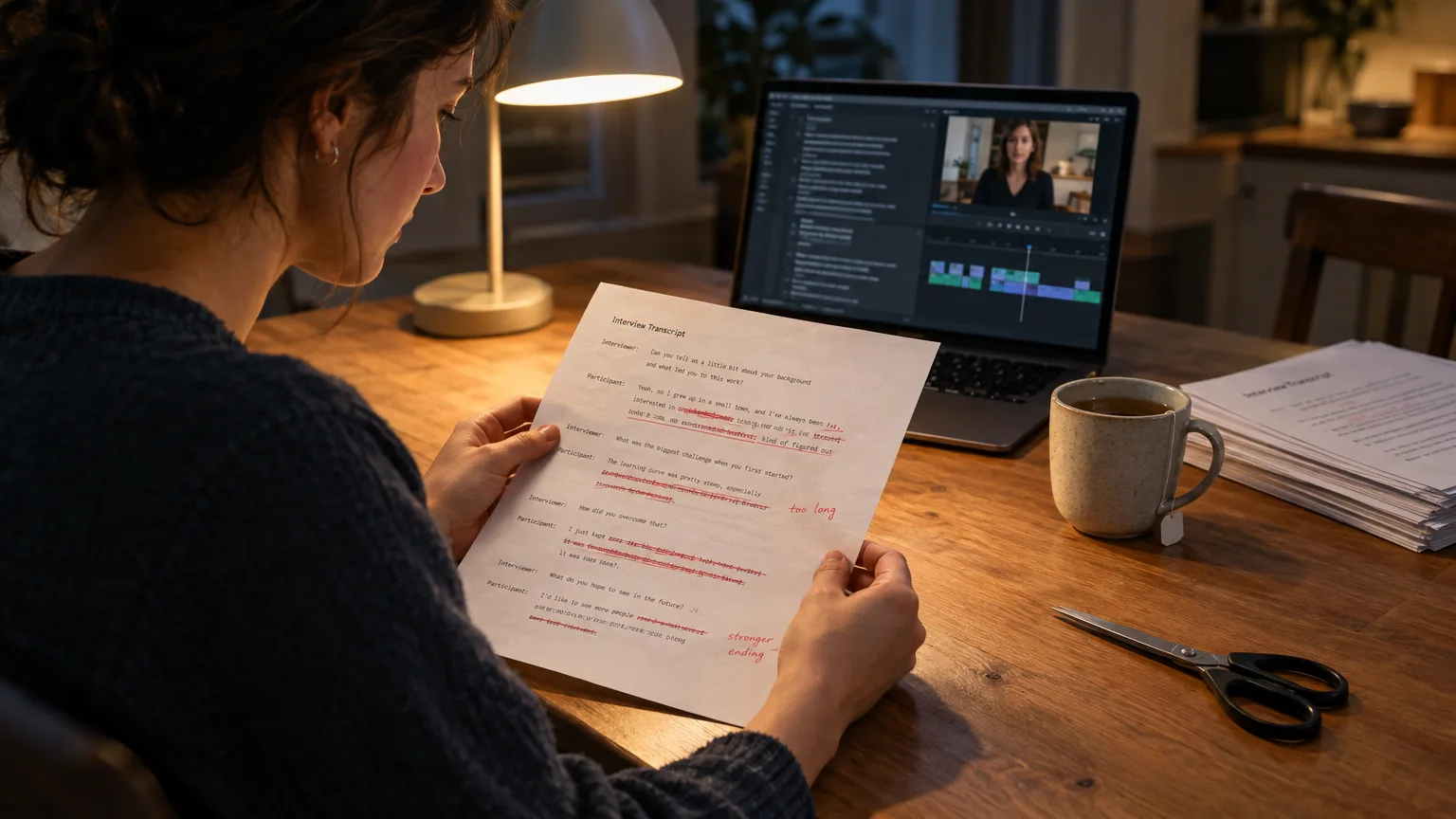
Take a reporter covering a factory closure. The assignment is ninety seconds, one package, airing at six. The reporter interviews the plant manager (on the record, prepared, careful), a laid-off worker of twenty-two years (emotional, rambling, one perfect line), and a local economist (dry but precise). None of that raw footage becomes a package on its own; it becomes a paper edit first, built from the transcript, before anyone touches a timeline.
- The manager's statement gets paraphrased in the VO, with the reporter noting that the company describes the closure as a financial decision and not a reflection on the local workforce, because the full answer ran forty seconds of corporate language with nothing quotable in it.
- The laid-off worker's line about finding out from a sign taped to the door after twenty-two years on the floor becomes the lead SOT: six seconds, devastating, runs at the top after a one-line setup naming the worker and the years on the job.
- The economist's clearest sentence on what the closure means for the county's tax base becomes the closing SOT, right before the reporter's sign-off.
That's three interviews distilled to two SOTs and a paraphrase, decided on paper before the editor opens an NLE. It's the same discipline described across most documentary post-production workflows, just compressed into a deadline measured in hours instead of weeks.
SOT Beyond the Newsroom
Does the SOT idea apply outside TV news?
Yes, even though nobody outside a newsroom calls it an SOT out loud. A testimonial video editor choosing which client line runs as a direct quote, versus which gets summarized in a voiceover, is making the exact same decision a news producer makes. A podcast video team deciding which thirty-second answer becomes a standalone social clip is picking an SOT by another name; they're just calling it a clip instead of a bite. The underlying rule doesn't change by industry: use the source's own words when their phrasing, tone, or authority is the point, and paraphrase or summarize everything else, because airtime (or watch time) is the one resource nobody gets more of.
That's also exactly where ScriptCut Social picks up once a long recording already exists: it finds the moments worth posting, frames them on the speaker, writes a caption and a platform-specific description for each one, and schedules the posts, with one link per client to approve before anything goes out. It posts directly to LinkedIn today; everywhere else, it prepares the clip and copy ready to post. The job is the same one a news producer does picking an SOT: find the ten seconds that was worth all the time it took to record the other two hours.
Common Mistakes
What trips up editors who are new to choosing SOTs?
- Using an SOT that only makes sense with context the audience doesn't have yet. Fix the sentence before the bite, not the bite itself.
- Running a bite that's technically clean but editorially flat. Clean audio and good framing don't make a quote worth airtime if it says nothing the VO couldn't say faster.
- Stitching two SOTs from different answers into one continuous-sounding quote. That's no longer a soundbite, that's a Frankenbite, and broadcast news holds an even higher bar on this than reality TV does: an SOT is supposed to be exactly what the person said, in the order they said it.
- Picking the SOT before checking the tone on playback. A line that reads perfectly in a transcript can land sarcastic, flat, or unintentionally funny once you actually hear it, which is exactly why every candidate needs a listen before it locks into the rundown.
Sources
- Sound on tape, Wikipedia
- Common Newsroom Terms, 101, NBCU Academy
- Writing for the Ear, LibreTexts Media Writing
- The Ultimate List of Broadcast Journalism Terms, NYFA
SOT is a small word for a big decision: which ten seconds of someone else's voice is worth the airtime, and everything else you'll say instead. We've watched that same decision play out in testimonials, podcasts and panel discussions as much as in news packages, and it always comes down to the same gut check: can the person say it better than you can summarize it. Here's how we'd start: mark every candidate SOT the moment the footage is transcribed, play each one back before it locks, and build the script around the ones that earn their airtime, with ScriptCut.
frequently asked questions
SOT stands for sound on tape, the broadcast term for a soundbite: an on-camera quote from a source other than the anchor or reporter, played in the source's own voice.
A VO is an anchor reading script over video with no soundbite, an SOT is the bite itself, and a VO/SOT combines both into a short studio-read story that includes one soundbite.
Yes, the two terms are used interchangeably in most TV newsrooms, with SOT being what shows up printed in a script or rundown and soundbite or bite being the spoken shorthand.
Most newsroom SOTs run about nine to ten seconds on average, with fifteen seconds treated as the practical upper limit for television news; documentary and long-form work can run longer.
An SOT can be technically perfect and still unusable if it needs context the VO hasn't set up yet, or if the person never actually lands a clear point in the clip.
No, stitching together words from different answers to sound like one continuous statement crosses into a Frankenbite, which breaks the basic promise that an SOT is exactly what the person said.
Yes, a testimonial editor or podcast producer choosing a direct quote over a paraphrase is making the same call a news producer makes when picking an SOT, even though the term itself stays mostly inside broadcast newsrooms.
You might also like...






Get the next ScriptCut article in your inbox
One short email a week. Editing tips and product news. No spam, unsubscribe anytime.
Start selecting.

Pick the story in the transcript, export a finished rough cut and ready to post short form video.
What are you looking for?
Get the ScriptCut newsletter
Thanks! Check your inbox to confirm.
Something went wrong. Please try again.