

One Half-Day Shoot, Five Deliverables by Friday: A Corporate Video Team's Playbook
Four executives, one conference room, six hours of booked crew time, and a Friday deadline for five different videos. Somewhere in that room someone is already asking whether the CMO's answer about 'customer obsession' will cut down to fifteen seconds for LinkedIn. (It will. It always does, eventually.) The fastest way to turn a half-day shoot into a hero video, a sizzle reel and a set of social clips by Friday is to select and approve the story once, then build every deliverable from that single approved set of picks instead of re-cutting the raw footage five separate times.
That sounds obvious written down. It is not how most teams actually work. Most teams shoot once and then edit five times, because five deliverables got treated as five separate editing jobs instead of one selection job with five exports. That is where the Friday deadline goes to die.
One Shoot, Five Cuts
How do you actually get five deliverables out of one half-day shoot?
You get them by separating the work into two different jobs: deciding what matters (once) and shaping it for each destination (five times, fast). A typical half-day corporate shoot, four exec interviews plus some b-roll of the office or the product floor, is commonly asked to produce a 90-second hero video for the website, a 60-second sizzle reel for the sales deck, and three or four social cutdowns for LinkedIn and Instagram. Production teams who plan this way describe it correctly: the crew, the gear and the location are booked for the day whether the team uses the day well or not, so the real efficiency lives in how many finished pieces come out of that one booking, as outlined by Mediabar Productions' breakdown of the one-shoot, many-cuts model. One agency frames the mindset shift bluntly: stop thinking of a shoot as producing one piece of content, and start thinking of it as building a small content ecosystem from a single production day, a point made in BreakthroughAll's writeup on getting more from one corporate shoot.
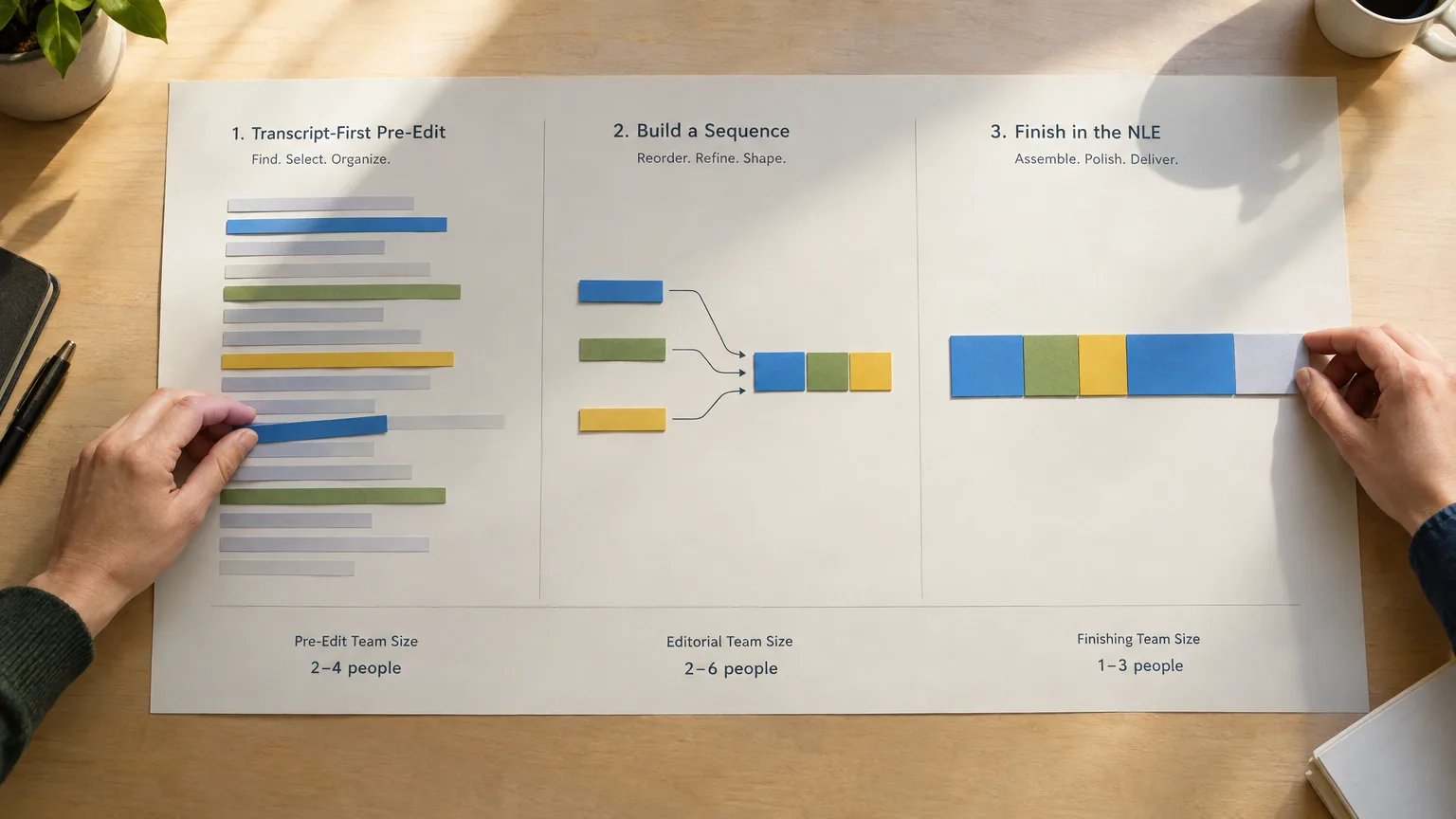
The trap is treating that list of five as five editing projects. It is one editing project: find the strongest 8 to 12 minutes of what the four execs actually said, put it in order, get it approved, and then every deliverable is a different length and aspect ratio pulled from the same approved spine. A-roll editing is the discipline that makes this possible: the talking is the story, and everything else (b-roll, graphics, music) wraps around it.
Logging Once
Do you need to log and select footage separately for each deliverable?
No, and doing so is the single biggest source of wasted hours on a multi-deliverable shoot. Log and select once, against the full transcript of all four interviews, marking every strong line regardless of which deliverable you think it belongs to. A line about company culture might end up in the hero video's opening thirty seconds and also stand alone as a fifteen-second LinkedIn clip. You will not know that until you have all the strong lines sitting next to each other on paper.
This is the paper edit step, and it works the same way on a corporate shoot as it does on a documentary: read, do not scrub. Pull the selects into a shortlist, arrange them into a narrative, and resist the urge to open the NLE until the story holds up on the page. Editors who skip this and start cutting video first routinely end up re-watching the same six hours of footage three or four times, once per deliverable, hunting for a line they vaguely remember a VP saying.
Approve Before You Multiply
Why should a client approve the story before you cut five versions of it?
Because an approval given after one cut exists does not protect the other four. If a VP's quote about 'q3 momentum' gets cut from the hero video after the client watches a rough cut, and that same quote is already sitting inside the sizzle reel and two social clips, you now have four re-edits instead of one. Get the paper edit, the ordered list of selected lines, approved before anyone touches a timeline. Getting client approval before you edit is cheap to do on a document; it is expensive to redo on four finished timelines.
Marketing teams who skip this step tend to describe the same failure pattern: a stakeholder weighs in late, after seeing the hero cut, and the note ripples backward into the sizzle reel and the social clips that already quietly launched the week before. Fixing it after launch costs a weekend nobody budgeted for, a pattern covered in more detail in how marketing teams fix the review loop before it costs a weekend.
Building the Stack
What order do you cut the hero video, sizzle reel, and clips in?
Cut longest to shortest, because the longer cut is the one that proves the story holds up and the shorter cuts are subtractions from it, not separate inventions. Build the 90-second hero video first from the approved selects. Once that is locked, the 60-second sizzle reel is largely a faster-paced remix of the same approved lines with tighter pacing and more b-roll coverage, closer in spirit to a sizzle reel than a scaled-down documentary. The social clips come last, because they are single, self-contained moments pulled straight from the approved selects list, no new editorial decisions required, just framing and captioning for the platform.
Worked example: a half-day shoot with the CEO, the VP of product, a customer-facing account manager, and a frontline employee, built around the launch of a new feature. The paper edit surfaces eleven strong lines across the four interviews. Six of them, in order, become the 90-second hero video for the website. A faster cut of eight of the eleven, reordered for energy rather than narrative logic, becomes the 60-second sizzle reel for the sales team's deck. Three of the eleven, the CEO's one-liner about why the feature exists, the customer's reaction, and the employee's quick explainer, become three separate 30- to 45-second social clips. Eleven approved lines. Three deliverables. Zero re-watching of raw footage after the paper edit was signed off.
The Rebuild Mistake
What's the most common mistake teams make with multi-deliverable shoots?
Re-cutting from scratch for every deliverable, as if each one were its own standalone project with its own scrubbing session through the same raw footage. It happens because the hero video and the social clips often get assigned to different editors, or get picked up weeks apart, and nobody hands over the selects list. The second editor opens the raw footage cold and starts over, finding roughly the same good lines the first editor already found, just slower and with slightly different in and out points that do not match the brand's approved story.
The fix is boring and effective: whoever builds the hero video keeps the full selects list, with timecodes, and that list becomes the shared source for every other deliverable. Nobody re-watches six hours of interviews to find the line about 'customer obsession' a second time. They search the approved transcript for it.
From Timeline to Posts
How do you turn the same interview into clips ready to post?
Once the hero video and sizzle reel are locked, the social clip set is a separate, faster pass: find the lines that stand alone out of context, frame them tight on the speaker, caption them, and write a platform-specific description for each one. That is a different skill from narrative editing, closer to what repurposing a webinar into short clips requires than to cutting a hero video, because a social clip has to work with no setup and no voiceover carrying it. Agencies that build these assets deliberately, rather than as an afterthought, report that a single well-planned shoot can supply weeks of distributable content, a pattern detailed in Southtown Productions' guide to turning one shoot into dozens of marketing assets.
This is the exact point where ScriptCut Social fits into the corporate video stack. Upload the long recording, or start from the ScriptCut edit already built for the hero video, and it finds the moments worth posting, frames them on the speaker, writes captions, drafts a description per platform, and schedules the posts, with one link per client to approve before anything goes out. LinkedIn is the only network it posts to directly today; Instagram, TikTok and YouTube still need the clip exported and posted by hand. For a corporate team pushing a CEO soundbite and a customer reaction out the same week the hero video launches, that is the difference between a Friday deadline and a weekend of manual clip-cutting.
The Friday Math
Is it realistic to deliver five cuts by Friday from a half-day shoot?
Yes, if the selection and approval happen on Monday or Tuesday, not Thursday. The math only works because the expensive part, finding and agreeing on the story, happens once and happens early. A half-day shoot on Monday, a paper edit and approval round on Tuesday, a locked hero video and sizzle reel on Wednesday, and social clips cut and scheduled on Thursday leaves Friday for the inevitable last-minute swap (there is always one line someone's boss wants removed).
This is where the manual workflow, scrubbing six hours of raw footage by hand across four deliverables, runs out of road. A faster path: drop the raw interviews into ScriptCut, let AI Select mark the strongest moments across all four interviews, use AI Story or AI Arrange to put the picks into a narrative, and run Cleanup to strip filler words before anyone sees a rough cut. The client reviews and approves that story on a share link before a single timeline exists. From there, the approved cut sends to DaVinci Resolve, Premiere Pro, Final Cut Pro or Avid, through the ScriptCut panel in Resolve and Premiere Pro or the Export menu's XML for Final Cut Pro and Avid, and the hero video, sizzle reel and social clips all come from that one locked frame-accurate timeline instead of five separate trips through the raw footage. The full tool set is described at ScriptCut's AI editing page, and the handoff details live at ScriptCut's NLE integration page.
Sources
frequently asked questions
A half-day shoot with three or four interviews typically supports a hero video, a shorter sizzle reel, and three to five social clips, as long as the selects are agreed once rather than re-found for each deliverable.
Cut the hero video first. It proves the story holds together, and the sizzle reel and social clips become faster subtractions from that approved spine rather than separate editorial decisions.
If the change touches a line used in other deliverables, flag it before the sizzle reel or social clips lock, which is why approving the paper edit before any cutting starts matters more than approving the finished hero video alone.
No, both usually draw from the same selected interview lines and the same b-roll; the sizzle reel just reorders and compresses for pace rather than narrative sequence.
Not fully. Tools like ScriptCut Social can post directly to LinkedIn today, but Instagram, TikTok and YouTube still require exporting the clip and posting it manually.
Re-watching the same raw interview footage separately for each deliverable because the selects and approval from the first cut were never shared with whoever built the others.
You might also like...








Get the next ScriptCut article in your inbox
One short email a week. Editing tips and product news. No spam, unsubscribe anytime.
Start selecting.

Pick the story in the transcript, export a finished rough cut and ready to post short form video.
What are you looking for?
Get the ScriptCut newsletter
Thanks! Check your inbox to confirm.
Something went wrong. Please try again.