

How to Edit a Customer Testimonial Video
A testimonial video converts when it centers on one specific, believable outcome: find the line where the customer names a real problem and a real result, cut everything that sounds coached, and land the whole thing in roughly 60 to 90 seconds. A testimonial is not a script your customer performs. It's evidence, and evidence only works when it still sounds like the person who lived it.
Most raw testimonial footage buries that evidence. People circle a point for two minutes before they land on the sentence that actually sells. The job of the edit is to find that sentence, protect it, and clear everything else out of its way.
The Converting Structure
Every testimonial that sells moves through three beats
The pattern is the problem before, the turning point, and the result after. You don't write this structure, you find it inside what the customer already said and reorder it. The before is the hook: a viewer with the same problem leans in the moment they hear it named. The turning point is where your product enters the story, briefly. The after is the payoff, and it needs a number or a concrete change, not a soft "it's been great."
If the footage gives you a line like "we cut our reporting time from two days to two hours," that sentence should shape the whole cut, not sit buried at minute six. Everything else in the edit exists to set that line up or let it land.
Finding The Line
Read the transcript before you touch the timeline
Reading the interview before cutting anything is the fastest way to find that line, because scrubbing eight minutes of video to relocate one sentence wastes time you don't need to spend. Get the interview transcribed with word-level timecode, read it once for the beats, and mark the sentences that hit problem, turn, or result, the same discipline covered in how to find the best soundbites in an interview. This is the paper edit approach applied to a single interview instead of a whole documentary: decide what survives on the page, where reading and comparing lines side by side is easy, before you ever open an NLE.
In ScriptCut you highlight the strongest lines directly on the transcript. Because every word carries its own timecode, each highlight is already a precise, frame-accurate cut, and you can drag the before, turn, and after into selling order before anything touches a timeline.
Authenticity Signals
Keep the specific detail, cut the slogan
A trained ear can usually tell which line came from a marketing brief. "Their customer service is second to none" could be said by anyone about anything. "I emailed at 11pm not expecting a reply and someone answered in ten minutes" could only be said by this one customer about this one experience. Keep the second kind and lose the first.
John Matera of Redtail Solutions, describing how his team films testimonials, put it plainly: "Don't worry about sticking to the script or order of questions, but finding the moments where that person is really jazzed up." That instinct applies just as hard in the edit. When you read the transcript cold, the slogans jump out as the lines that sound rehearsed. The specific, oddly detailed ones are almost always the ones worth keeping.
The Legal Line
Where trimming ends and frankenbiting begins
Trimming a rambling answer down to its clearest sentence is normal editing. Splicing "this product" from one answer onto "changed my business" from another to manufacture a quote the customer never said is a different act, and it isn't just a taste problem. The FTC's endorsement guides (16 CFR Part 255) require that a testimonial reflect the honest opinion of the person giving it and that it not be reworded or reassembled in a way that distorts what they actually said or meant.
The practical rule: cut within a sentence to remove a stumble, cut around a sentence to remove a tangent, but don't build a sentence out of parts from two different answers. Every claim in the final cut should be traceable to one continuous moment the customer actually said. If you're unsure whether a cut crosses that line, play the moment back for the customer before you publish. It costs one email and it protects both of you.
Case In Point
From eight minutes of rambling to a 90-second cut
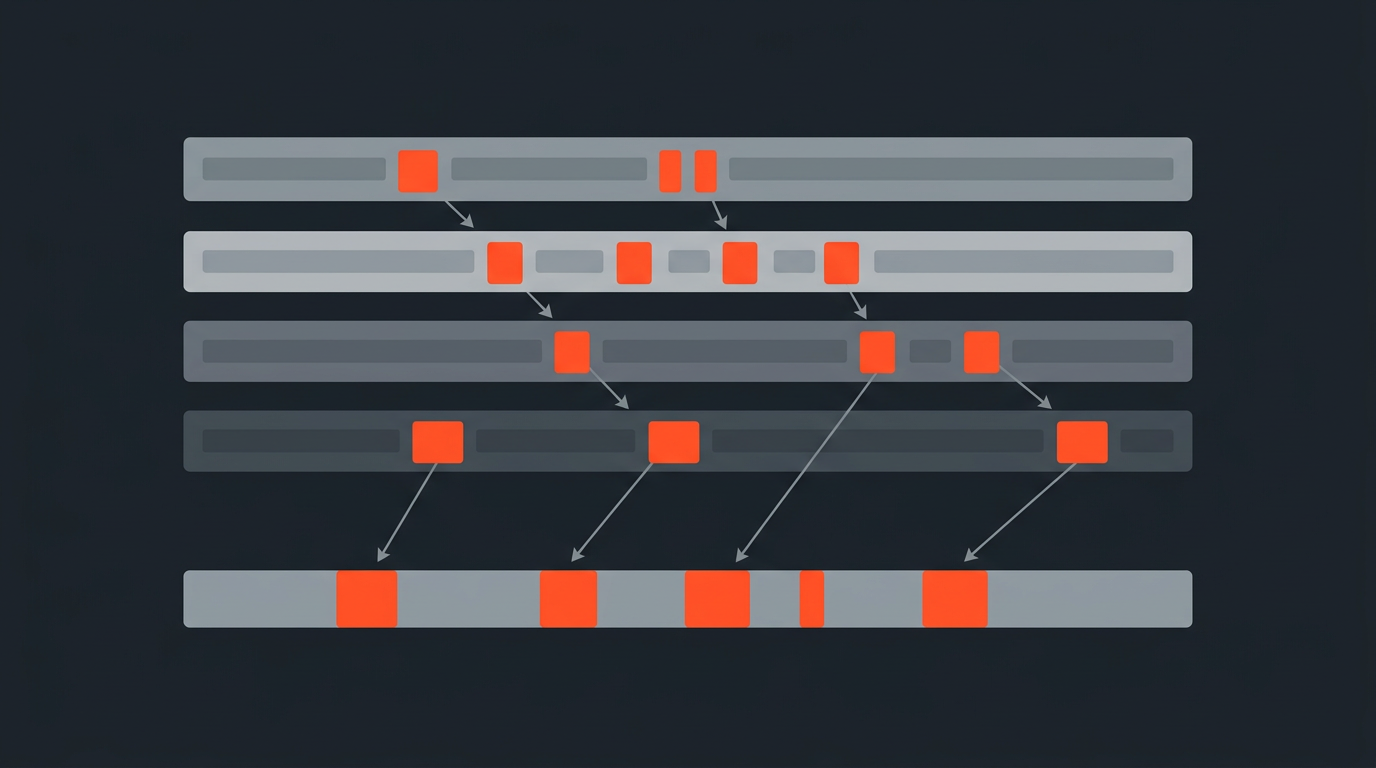
Picture eight minutes of a customer talking with no structure to speak of. Reading the transcript, you find the pieces scattered out of order: two minutes in, she describes the chaos before your product; five minutes in, she mentions trying it; seven minutes in, she says the number that matters, a 40 percent drop in support tickets in the first month. You mark those three lines plus a short, warm sign-off near the end, then trim the false starts inside each one.
Reordered, the cut opens cold on the number, moves back to the problem that explains why it mattered, cuts to the moment she describes trying your product, and closes on the sign-off. Ninety seconds, nothing scripted, every word hers. You play it back once to check it still sounds like a person and not a highlight reel, then export the sequence to your editor to add b-roll and lower thirds.
Notice what didn't happen in that process: no re-watching the full eight minutes a second time to relocate the sign-off, no scrubbing back and forth guessing where the 40 percent line started and ended. Every mark you made on the transcript already carried its own in and out point, so assembling the order was a drag-and-drop exercise on the page, not a search through raw footage.
Here is what that same kind of edit looks like step by step inside an NLE, once the strongest lines have already been marked:
Visual Support And Length
Let b-roll cover the cut, and size the length to the platform
Once the words are locked, b-roll has one job: hide the join between two moments that weren't originally adjacent and give the eye somewhere to rest while the voice keeps carrying the story. That's a different goal from making the video look busy. A hard cut on a talking head every few seconds reads as choppy; the same cut covered by two seconds of product or workplace footage reads as a scene change. Shoot or source the b-roll after the transcript-level cut is locked, not before, so you know exactly which moments need covering instead of guessing at coverage during the shoot.
Length should follow the same logic. A testimonial embedded on a pricing or product page can run closer to 90 seconds, because a visitor who scrolled that far already wants proof. The same story cut for a social feed needs to work in the first three seconds with the sound off.
A testimonial embedded on a pricing or product page can run closer to 90 seconds, because a visitor who scrolled that far already wants proof. The same story cut for a social feed needs to work in the first three seconds with the sound off. Several publishers, including LittleThings as reported by Digiday, have said the large majority of their video views happen muted, which is why captions on a testimonial aren't a nice-to-have, they're how most people will actually receive the line you worked to isolate.
Cut two versions from the same selects if you can: a longer one with the full before-turn-after arc for the website, and a tight 15 to 30 second version built around just the result line for social. Both come from the same transcript markup, so the second cut is a re-order, not a re-edit.
Common Mistakes
Where testimonial edits lose the sale
Opening with your company instead of the customer's problem. Nobody cares about your product in the first three seconds. They care whether you understand what they're dealing with. Open on the before.
Keeping the vague praise. "Amazing experience" sells nothing. If a line could describe a sandwich shop as easily as your product, cut it.
Over-trimming until it sounds clipped. A testimonial cut too tight starts to feel produced, which undercuts the exact believability you're going for. Leave room for a breath. A small stumble that survives the edit can do more work than a perfectly clean sentence.
Skipping a release or consent check. Before you publish, confirm the customer knows how the clip will be used. It's a five-minute step that avoids a much longer one later.
The Tradeoff
Polish costs you the believability you're chasing
Push a testimonial toward polish and you end up with something that plays like an actor reading lines. Leave it too raw and it wanders, loses the viewer, and never delivers the number that was supposed to close the deal. The transcript-first approach helps because it separates two decisions that usually get tangled together: what to keep, which you decide on the page where comparing lines is fast, and how it sounds, which you only judge once by ear, on the assembled cut, before you finish.
Treat the first pass on the page as structural, not final. Once the order holds up, watch it once straight through with sound and ask a single question: does this still sound like a conversation, or does it sound like an edit. If it sounds like an edit, the fix is almost never a tighter cut. It's usually one more beat of breathing room back where you trimmed hardest.
Handoff
Turn the selects into a timeline your editor can finish
Once the transcript-level cut holds up, the last step is getting it into an NLE without rebuilding it by hand. A tool built around word-level timecode can turn your highlighted selects directly into a sequence: an EDL or XML that opens in DaVinci Resolve, Premiere Pro, Final Cut, or Avid with your cuts already in place, ready for b-roll, music, and lower thirds. Compare that to the alternative, which is re-watching the raw footage a second time just to find the same in-points you already marked on the page. See the full transcript-to-timeline workflow for how that handoff works end to end, and if testimonials are one piece of a bigger content operation, the same method scales to a full marketing team's video pipeline.
Sources
frequently asked questions
Most testimonials work best between 60 and 90 seconds on a website or landing page, and 15 to 30 seconds on social feeds. Length matters less than whether the result line lands early.
Yes. Reordering sentences the customer actually said is standard editing. What crosses the line is combining fragments from different answers to build a sentence they never said.
Read the transcript instead of scrubbing the video. Mark the sentences that name a specific problem, a turning point, or a concrete result, then build the cut from those marks.
No. A few natural pauses keep the testimonial sounding like a real person. Removing every hesitation makes the cut feel produced, which undercuts credibility.
Yes. Confirm the customer knows how and where the clip will be used before it goes live, even for an informal or short-form cut.
An XML or EDL that carries your in and out points into DaVinci Resolve, Premiere Pro, Final Cut, or Avid, so the editor starts from your structure instead of raw footage.
AI transcription and word-level timecode speed up finding and cutting the right lines, but judgment calls like which line is believable and how much polish is too much still need a human read.
You might also like...


Start selecting.

Pick the story in the transcript, export a finished rough cut.